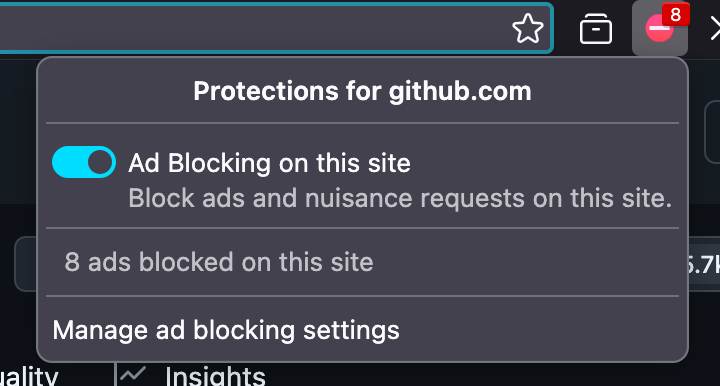
To test drive this I needed to apply some configuration tweaks, but the built-in ad blocker seems to just work. I tried it out on YouTube and a few other sites, and I haven’t seen so much as a hitch.
Here’s a look at the configuration screen, which currently resides at the top of Settings > Privacy:
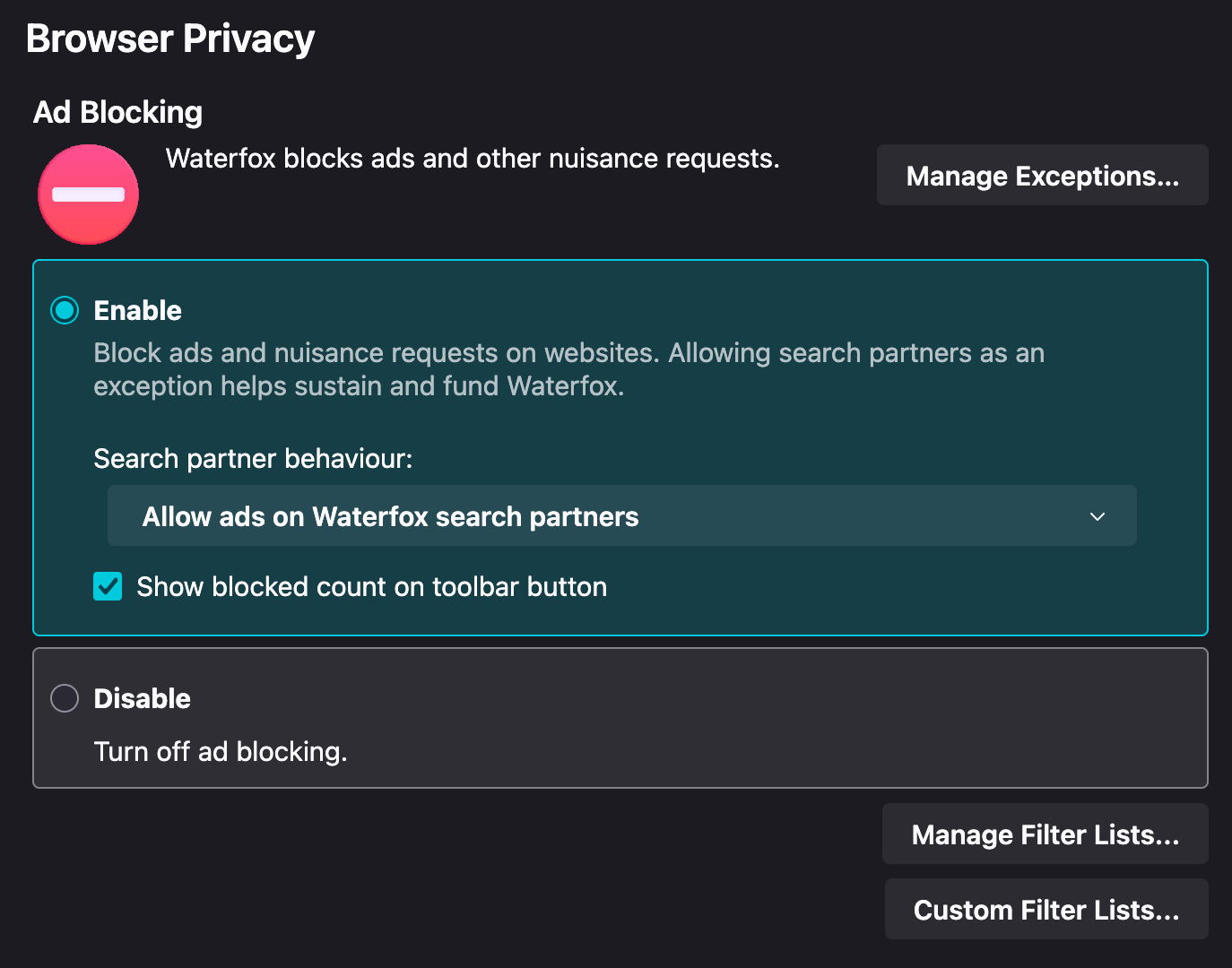
Ads from the default search provider are enabled (per their request), but disabling them is pretty straightforward. Other functionality, like toggling the default filter lists (12 are enabled by default) or adding your own are accessible via buttons.
Lists enabled by default:
- Default
- EasyList
- EasyPrivacy
- uBO Filters
- uBO quick-fixes
- uBO unbreak
- Privacy
- AdGuard Tracking Protection
- Peter Lowe’s Ad and Tracking Server List
- uBO Badware
- uBO Privacy
- uBO Resource Abuse
- Annoyances
- EasyCookie
- uBO annoyances-cookies
Other available lists:
- Fanboy’s Annoyances
- Fanboy’s Anti-Chat
- Fanboy’s Anti-Newsletter
- Fanboy’s Mobile Notifications
- Fanboy’s Social
- 34 more Regional lists
Or you can disable and just use uBlock Origin like you do already
My understanding is that this ad blocker is running at rhe browser engine level and is therefore faster and more powerful than a JavaScript tool limited by the manifest API. I love uBlock origin and have been using it for years, but if this is better, why be hostile to it?
Because this is from Brave which doesn’t have the greatest rep.
It’s a Rust implementation of ad blocking, which is separate from the Brave code people don’t like.
If we wrote off all code written by bigots, we couldn’t use old Firefox code. Or new Firefox code.
I’d be fine with that.
ublock origin blocks better than the browser in built ones anyways.
Excuse me, you mean the uBlock Origin fork AdNauseam, which goes a step further and intentionally garbles up advertisers’ click data by clicking every ad without loading the resulting content. uBO is old news in light of AN. Don’t just take their crap; fight back!
It’s an interesting idea, but I’d rather not make any requests at all to the advertisers’ servers, even if it’s done in the background without me seeing the ads.
That’s the fun thing, it registers “a click” but doesn’t actually load the content because that can lead to drive-by and one click malware.
It does give data to advertisers, but the effect is much more dramatic than you might think. For me, it has completely nuked the advertisers’ profile of me to the point that the mail I get is obviously affected too. I was getting normal mail before using, but then for a few years I was getting senior citizen related mail and travel brochures, now I am getting coupons relating to pregnancies and personal injury ads. Recently I have been getting texts from realtors asking if I want to sell “my house”. Grain of salt is important, I tend to go to random websites, if you have specific interests and regularly and mostly exclusively go to websites related to them, then this scheme would not work. Simply avoiding the ads in the first place would be superior.
Interesting, that sucks. The only change I experienced was the loss of Google rewards surveys (which is fine, meh), after Google sent me several surveys asking if I was, in fact, researching XYZ items with the intent to buy. They picked up on it but my physical mail never changed, as far as I know.
you have specific interests and regularly and mostly exclusively go to websites related to them
You just described me quite well…
The texts trying to buy your home are just the latest trend in SMS scamming. That is unrelated to AN, for sure.
Tried it, but found it less reliable