

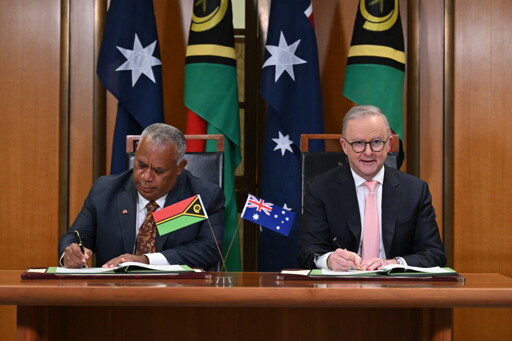
Australia and Vanuatu signed a long-awaited bilateral security and economic treaty Monday that prevents China creating a military base on the South Pacific island nation.
Australian Prime Minister Anthony Albanese signed the so-called Nakamal Agreement with his Vanuatu counterpart, Jotham Napat, in the Australian capital nine months after the Vanuatuan government rejected an earlier draft. Vanuatu had feared the deal would limit its ability to attract infrastructure investment.
“Our agreement reflects and confirms Australia’s role as Vanuatu’s largest and most comprehensive economic, security and development partner, a responsibility that we take seriously,” Albanese told reporters.
Natap said the pact “reaffirms our shared commitment to continuing and strengthening the comprehensive partnership between our two countries, founded on mutual respect, trust and our common vision for a peaceful, stable and prosperous Pacific.”
…
Vanuatu also agrees to come to Australia, New Zealand and France first in response to major natural disasters.
Australia had proposed to provide Vanuatu with 500 million Australian dollars ($344 million) over a decade under the terms of the agreement as originally drafted.
…
Your remarks are false and misleading.
China maintains army support bases not only in Cambodia but also in Djibouti and Tajikistan.
It is also noteworthy that China pursues a dual-track strategy across the Indo-Pacific, escalating military and diplomatic pressure on some countries (of late particularly on Taiwan, Japan, and the Philippines) while deepening economic ties with other Asian countries, although these economic partnerships benefit often exclusively China.
In addition, China’s activities in the Indo-Pacific has been growing in recent years with the most recent warning coming from New Zealand’s intelligence service over Chinese military forays in the Pacific,
We must also note that China has increased its military spending from 700 billion dollars in the 1990s to almost 3 trillion dollars in 2025, according to the Stockholm International Peace Research Institute. It is by far the largest military spending increase during peace time.