

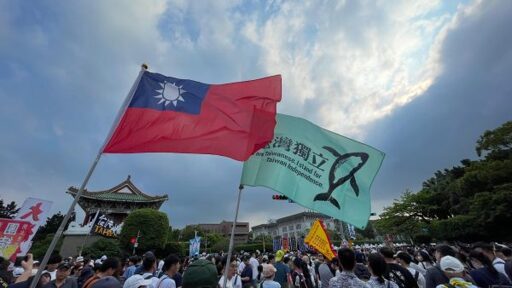
Op-ed by Kolas Yotaka, a Taiwan-based adviser and former senior government official. A former spokesperson for Taiwan’s Presidential Office and, before that, Cabinet spokesperson under Premier (now President) Lai Ching-te, she currently holds an affiliated research position at Keio University’s Global Research Institute in Tokyo.
[…]
[Mainland China’s] ethnic unity law treats Taiwanese people as citizens of the PRC. Article 21 mandates that the Chinese Communist Party work to “strengthen the sense of belonging, identification, and honor of Taiwan compatriots toward the Chinese nation,” to “promote the joint inheritance and promotion of Chinese culture by compatriots on both sides of the strait,” and to deepen the recognition that both sides “belong to Chinese culture” and are both “Chinese people.”
The law includes a reporting mechanism: any individual can be reported and prosecuted. Any Taiwanese person who does not identify as Chinese is, under its terms, committing a crime subject to criminal liability.
[…]
In Taiwan, what was once a matter of personal national identity will become the target of public prosecution. And the vast majority of Taiwanese are guilty of this “thought crime.” According to polling conducted across multiple firms, roughly two-thirds of Taiwan’s population identify primarily as Taiwanese. Fewer than 3 percent primarily see themselves as Chinese. Among younger Taiwanese, those aged 18-34, the gap is even wider: over 80 percent identify as primarily Taiwanese; just one percent as primarily Chinese.
This is not a surprise. Among Taiwan’s 23 million people, roughly 600,000 are indigenous, Polynesian peoples entirely distinct from China’s Han majority in language, culture, society, and belief. More than a million are new residents, originally from Vietnam, Indonesia, Japan, Hong Kong, Macau, and parts of mainland China; they and their descendants constitute what many regard as a new cultural wave in Taiwan. There are those who came to Taiwan with Chiang Kai-shek after 1949, some of whom retain deep feelings for China.
[…]
Taiwan’s largest population group consists of people whose ancestors migrated from coastal southeastern China roughly 400 years ago, who have long since developed distinct cultures, and identities. Their ancestors came from China. That does not mean they still identify as Chinese, any more than Americans whose ancestors came from England, Germany, or the Netherlands still call themselves British, German, or Dutch.
[…]
This diversity is what makes Taiwan distinct from China, and it is the strongest argument for Taiwan’s right to self-determination. It is precisely what blocks the CCP’s [Chinese Communist Party’s] goal of unification, and precisely what the CCP fears most.
[…]
Years of CCP intimidation, combined with the spread of AI and algorithmic amplification, have pushed Taiwanese public opinion toward the extreme ends of the spectrum. The specter of populism hangs over the country […] The CCP is using law to formalize its political objectives, exploiting existing distrust to spread both hatred and Chinese identity narratives from within. Taiwan’s freedom of expression is being used as a weapon against itself.
[…]
This is not hyperbole; it is a serious matter. If Beijing gets it wish, Taiwan will become the next Hong Kong, or Tibet, or Xinjiang. That would not bring stability to the Indo-Pacific, nor would it help a global economy that depends on advanced semiconductors.
[…]
On July 1, Taiwanese will start fighting a new battle. We face this challenge increasingly alone, with our democracy on the line.
Thing is: she’s such an amazingly wonderful person that I really don’t feel the need to sully any moments by bringing up such contentious subject matter. She really is a delight.
Not only is she the wife of my brother, she’s also the mother to my nine-year-old nephew and five-year-old niece. At this point, bringing up such matters… I would be the asshole if I did. She’s a citizen now and certainly, so are my niece and nephew. It’s not as if she owes anyone an explanation for anything.
I agree with you on that, it’s not worth it in that situation. I’ve been surprised though, some of the people I’ve talked to chose to stay in my country because they weren’t happy with the authoritarian government in China.