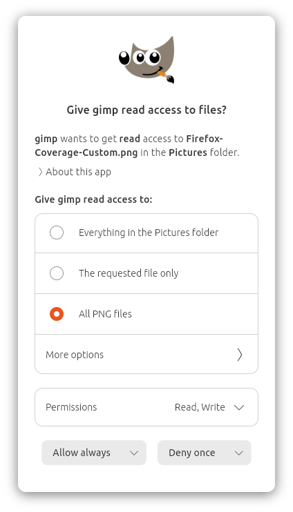
My name is Oliver Calder and I am part of the Snapd team at Canonical. In this post, I’m excited to share some more information about a project I’ve been working on over several years with a talented group of people across the AppArmor, Desktop, Design, and Snapd teams: Permissions Prompting. Permissions Prompting is a new layer of user-defined security which empowers users to control at runtime the level of access applications have to the host system. There was an excellent post from around t...
Not really though? Or rather - then answer the other half. Why are flatpaks, deb, rpm, arch, etc. ALL able to update in place? But with snaps we need that sucker closed? It sucks to use like that.


Not really though? Or rather - then answer the other half. Why are flatpaks, deb, rpm, arch, etc. ALL able to update in place? But with snaps we need that sucker closed? It sucks to use like that.
Because the app isn’t updated until it’s restarted.
Do you think you applied that Firefox security update because you updated the flatpak? Because you haven’t if you left your browser running.
Did I explicitly state that I was aware of how this worked in my original comment? I did? Oh good.
I don’t care if Firefox isn’t updated until I restart it. I just don’t want that terrible workflow:
Click update all. Firefox is open, therefore won’t update until you click update again.
Every other package manager: Click update. All apps update. When I am ready to close Firefox it’ll be updated next time I use it.
Hence my “asked and answered” response. 🙄
The problem is that you have to break your workflow to update shit, or you have to do updates multiple times to work around the things you’re doing.