

cross-posted from: https://scribe.disroot.org/post/8805415
Op-ed by Rushan Abbas, Founder and Executive Director of Campaign for Uyghurs.
For nearly four decades, I have advocated for justice and human rights for the Uyghur people in the face of the Chinese Communist Party’s (CCP) oppression. Its record of gross human rights violations is well documented, despite an extensive propaganda apparatus designed to obscure it. China’s use of economic leverage to expand its political influence is also widely recognized, with overt examples across the globe. What is often less visible is the breadth and depth of what the CCP is willing to do, and the lengths it will go, to sustain control and project power.
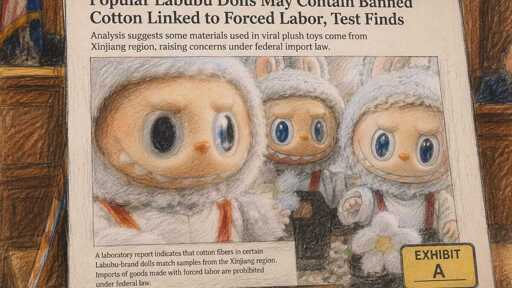
On April 23, an investigative report from the New York Times uncovered evidence linking Pop Mart’s Labubu dolls to state-imposed Uyghur forced labor. Independent testing confirmed that the clothing on 16 out of 20 Labubu dolls was made of cotton sourced from East Turkistan, now known by its colonial name: Xinjiang Uyghur Autonomous Region. In 2021, a motion was passed in Canada, 266 to 0, recognizing the CCP’s actions against Uyghurs as genocide.
…
Firsthand testimony from a former Han Chinese police officer who served in the region from 2014 to 2023 confirmed that state-imposed Uyghur forced labor continues and has become deliberately harder to detect. The witness described government convoys escorted by armed forces, confiscation of identity cards to prevent escape, and strict prohibitions on prayer and religious expression for workers in cotton fields. Hidden within Labubu’s blind boxes are the traces of this systematic oppression.
The presence of Pop Mart vending machines in major international transit hubs, such as Washington Union Station and Toronto Pearson Airport, directly connects consumers to the ongoing genocide. China has leveraged pop culture and consumer branding to whitewash its forced labor and systemic oppression.
…
Tainted toys, apparel, and electronics, as well as vehicles and agricultural goods, are flooding the Canadian market.
…
Canada’s recent agreement to import 49,000 Chinese-made Electrical Vehicles (EVs) into the country is one of such examples. EV production is already deeply entangled with Uyghur forced labor, from aluminum and battery inputs sourced in the Uyghur region to processing factories linked to coercive labor transfers. At least nine factories connected to BYD, China’s EV powerhouse, are participating in the forced Uyghur labour transfer programs.
These facts make MP Michael Ma’s grilling of respected academic and China expert Margaret McCuaig-Johnston egregious. Deploying the age-old propaganda language, “Have you ever seen [forced labor] yourself, in person,” Ma tried to bury well-documented evidence of Uyghur forced labor.
This remark is deeply hurtful for the millions who are suffering under the CCP’s oppression, including my family.
My sister, Dr. Gulshan Abbas, was detained by the Chinese regime in 2018, just days after I spoke at a think tank in Washington, D.C., about the CCP’s genocidal policies. She has been held in the CCP’s dark dungeon for almost eight years. Her enforced disappearance is a warning that my voice, even as an American citizen, carries a price. Gulshan could have been coerced into the factory producing car parts that ultimately enter Canadian markets, or forced to pick the cotton that is later woven into products like Labubu dolls.
And her case is not unique. Many Canadians have faced the same fate by the same regime.
…
Since 2022, the U.S. has stopped nearly 10,000 shipments, worth $3.5 billion. In contrast, Canada’s model has blocked just two shipments, while imports from the Uyghur region to Canada have surged 160% to over $600 million. Canada must seize the moment to reverse course and do everything it can to stop any forced labor products from crossing its border.
…
During my advocacy trip to Ottawa from April 21 to 23, I met with parliamentarians across party lines and spoke at a press conference for Bill C-251, an Act to amend the Customs Act and the Customs Tariff, which shifts the burden of proof from the government to the importing entity. Modern slavery is not a partisan issue, nor should it be reduced to a political agenda. When a country pledges to combat forced labor, that commitment must hold.
…
As global citizens, we must demand action, not only for the Uyghurs. If we normalize authoritarian systems and continue business as usual, we risk losing the leverage that protects our values that sustains a free society. In the long term, we risk far more: the ability to raise our children in safety, to speak and believe freely, and to live without fear. Canada, like all governments, cannot afford indifference in the face of the CCP’s increasingly sophisticated and often obscured methods of consolidating power and projecting influence globally.
The time for “business as usual” is over. If Canada is to uphold its 2021 recognition of the Uyghur genocide, it must act with the urgency that such a declaration demands.
We call on the Canadian Parliament to pass Bill C-251 without delay. We must stop putting the burden on victims to prove their suffering and instead demand that companies prove their profits are clean. Furthermore, Canadian consumers and institutions must reject brands like Pop Mart that bring the products of forced labor into Canadians’ daily lives.
…
Canada must choose: will it remain an enabler of the CCP’s forced labor regime, or will it be a leader in the global fight for human dignity? The world is watching.
In 2023, Canada passed a motion to resettle 10,000 Uyghurs and other Turkic muslims from China by the end of 2026. Since the Canada-China trade deal has been finalized, the Carney government has not yet said whether or not it feels committed to it, though.
The simple math is, for almost every forced-laborer “blocked”(real-speak: denied entry, or deported upol discoveryd…), China will bring-in a CCP shill. If the forced-laborer isn’t qualified to do the work, then why try to smuggle them in? … but are only those qualified to do the work “worthy” of asylum? Once you’ve ensured they get paid appropriately(by China…) and treated with respect, they are no longer forced-labor…
… but yeah, x workers are going to be required to do the work. If a portion of them are “accidentally” liberated from hellish conditions back home, and their oppressors jailed, how is that not a win?
Save some (more)Uyghurs and arrest some human traffickers, versus force China to bring-in only spies and shills, because the best way to solve a problem is to deal with oppressors so long as they agree to leave their worst-off victims back home.
Yes, my way you end up with more bodies, and resources to house and feed imprissoned traffickers, but that’s why you send China the bill. It could ultimately be cheaper for Canada to do the right thing.