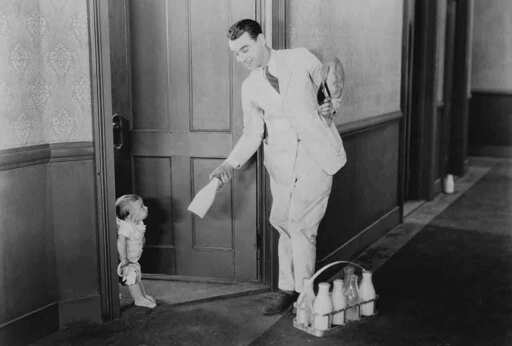
I’m pretty sure most people were like “yeah that’s a bullshit job” except milkman, lots of perks to being a milkman.
But, Resurrectionist even the people who had that job didn’t think they wete “irreplaceable”.
Jokes on you, milkmen are coming back into trend - at least here in London.
- Article Writer
Once upon a time, humans liked to read articles written by other humans. Since these human writers were capable of doing more than just predicting the next token, they were able to maintain a sense of coherency and continuity through their articles and could write lists that referenced other items, especially when they were closely related, instead of each item just following an intro, brief description, conclusion format that gets quite repetitive. But then text predictors got good enough to predict coherent sentences that are often even accurate and can follow a given theme or topic and websites thought no one would care since it was mostly marketing and propaganda by then anyways and dropped the human writers into active volcanoes.
These individuals illegally exhumed bodies from graveyards and sold them to medical institutions.
Criminal enterprise counts as a job?
List includes both switchboard operators and switchboard managers. Where is the pin setter manager? The elevator operator manager?
Projectionists were responsible for operating film projectors in movie theaters, ensuring that films were displayed correctly for audiences.
Projectionist is still a job that exists even if the tools they use has changed.
Typesetters still exist even if their tools have changed.
Looking ahead, what other jobs might we see fade away as new technologies and trends emerge?
I bet this article is clickbait for ‘AI is going to take jobs’.
Criminal enterprise counts as a job?
Ha ha, this one snagged me as well. Body-snatching declined because graveyards employed night watchmen (maybe that’s a job that disappeared?) and wealthy families had metal “mortsafes” built on fresh graves. The bodies of executed criminals had always been available for dissection, but demand outstripped supply.
10. Telegraph Operator
The OM who taught me Morse code when I passed my ham radio license in the 80s was a long-retired telegraph operator. He recounted how he got his job:
He saw a ad for a job at his local Western Union telegraph office in the classifieds. He was already a ham radio enthusiast, so he figured he’d give it a shot. He showed up at the date and time indicated in the ad and sat in the waiting room with a bunch of other candidates for a long time. Nobody showed up to interview anybody. So he waited with all the others.
Then finally he got up and went straight to the recruiter’s office without prompting. He said he suddenly realized, while he was waiting there, that among the machinery noises and the clickety-clicks of the paddles, someone was continuously keying “If you can read this, go straight to the recruiter’s door.”
The office wanted only the very best telegraphists who lived and breathed the job. They figured someone who automatically listening to Morse code traffic when they heard something, and not just while on the job, was the kind of person they wanted.
That was part of a plot of a science fiction story that I can’t quite remember. The government was screening for psychics for a special branch. The applicants would show up and wait in a room with a psychic blasting “go through the small door”.
Straight clickbait. My first thought before I clicked through was “I better not see knocker-upper in there…”. It was job number 1. No one thought these jobs were irreplaceable, many of them are just tasks in a larger process or the function still exists in a different context.
Projectionist is a forgotten job? That’s not only in my lifetime, my son was a projectionist. He ended up being the one to go to the various theaters training others to use digital projectors.
I still had a milkman in the UK. The entire city of Lancaster has milkmen, they divvied up the place amongst them. If you are lucky you are in the area run by two farmers who deliver right from the farm.
And we still have delivery people. The function has never gone away.
Milkmen were important for milkmen jokes.
… there is more grocery delivering going on right now than ever before.
I bet Grubhub delivers 10,000 gallons of milk a day.
- Elevator Operator
My great-grandfather was an elevator operator in NYC in the early 1900s.

https://en.wikipedia.org/wiki/Otis_Worldwide#History
In 1925, the world’s first fully automatic elevator, Collective Control, was introduced. In 1931, the company installed the world’s first double-deck elevator at 70 Pine Street in New York City.[11][12]
End of an era.
They are still a union protected job on construction sites and the docks in NYC.
- Lamplighter
Lamplighters were responsible for lighting and extinguishing gas street lamps in towns and cities before electric lighting became standard. They typically carried ladders and torches to perform their duties. The job was crucial for maintaining public safety during the evenings. However, with the introduction of electric streetlights, the need for manual lamp maintenance disappeared, leading to the decline of this occupation. Lamplighters are now part of history, representing a bygone era of urban infrastructure.
The lamplighters themselves were machine operators that replaced earlier professions.
https://en.wikipedia.org/wiki/Link-boy
A link-boy (or link boy or linkboy) was a boy who carried a flaming torch to light the way for pedestrians at night. Linkboys were common in London in the days before the introduction of gas lighting in the early to mid 19th century.
That’s a door to door bowling pin salesman. They ended in 2018.
https://en.wikipedia.org/wiki/Washerwoman
A washerwoman or laundress was a person, usually a woman, employed to wash laundry by hand, before the widespread use of washing machines and commercial laundries. The profession existed in many cultures, spanning from antiquity to the early modern period. While the profession has historically been gendered, often associated with women, in some contexts, men also performed laundry labor. It was typically low-paid, physically arduous, and associated with lower social status.
The occupation began to decline with the rise of commercial laundries. The spread of domestic washing machines and self-service laundries further reduced the need for the independent washerwomen profession. By the late twentieth century, the profession had largely disappeared in industrialized countries.

https://en.wikipedia.org/wiki/Hostler
A hostler (/ˈhɒslər/ or /ˈɒslər/) or ostler /ˈɒslər/ was traditionally a groom or stableman who was employed in a stable to take care of horses, usually at an inn, in the era of transportation by horse or horse-drawn carriage.[1]
https://en.wikipedia.org/wiki/Filling_station_attendant
A filling station attendant or gas station attendant (also known as a gas jockey in the US and Canada[1][2]) is a worker at a full-service filling station who performs services other than accepting payment. Tasks usually include pumping fuel, cleaning windshields, and checking vehicle oil levels. Prior to the introduction of self-starting vehicle engines, attendants would also start vehicle engines by manually turning the crankshaft with a hand crank.
In the United States, gas jockeys were often tipped for their services,[3] but this is now rare as full-service stations are uncommon except in New Jersey, 16 “urban” counties in Oregon, 4 cities in Massachusetts, and the town of Huntington, New York, where there are laws or restrictions against letting customers pump their own gasoline.
“We don’t pump our gas, we pump our fists!”
Not a single mention of night soil collectors.