uhm, that’s not economical. to effectively transform a worldwide energy supply (that’s a very high amount of energy throughput), you need economic advantage. and this isn’t it. please put the solar panels at an angle sothat they collect more sunlight or the solar park isn’t gonna pay itself off anytime soon.
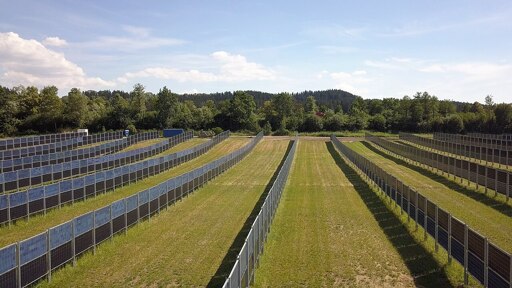
The University of York compared panels capable of 1.5 kW and found that vertically mounted bifacial panels generally outperformed tilt mounted monofacial panels, by between 14-27% on a monthly basis, at least when surrounded by gravel, in the climate/altitude of that particular location.
The reason given is that vertically mounted systems capture a lot more indirect reflected sunlight from the surroundings, across a wider range of conditions.
Vertical solar panels are looking to be quite economical. While there power per panel surface is lower, the timing of peak outputs is an excellent complement to standard solar. It has maximum output in the morning and evenings, when people want to run home appliances etc, rather than at midday when they are all at work.
It also uses less land. Rather than giving up 100% of a field to solar, A farmer can give up 20%, leaving the rest for crops or livestock. Apparently sheep do particularly well in this setup. The panels provide shade, and more diversity in plant types to eat. They actually do better than those in an empty field of the same size.
While there power per panel surface is lower, the timing of peak outputs is an excellent complement to standard solar. It has maximum output in the morning and evenings, when people want to run home appliances etc, rather than at midday when they are all at work.
yeah i’m well aware of that. the problem is more that you can more effectively shift power around from midday to evening and morning with batteries.


uhm, that’s not economical. to effectively transform a worldwide energy supply (that’s a very high amount of energy throughput), you need economic advantage. and this isn’t it. please put the solar panels at an angle sothat they collect more sunlight or the solar park isn’t gonna pay itself off anytime soon.
The University of York compared panels capable of 1.5 kW and found that vertically mounted bifacial panels generally outperformed tilt mounted monofacial panels, by between 14-27% on a monthly basis, at least when surrounded by gravel, in the climate/altitude of that particular location.
The reason given is that vertically mounted systems capture a lot more indirect reflected sunlight from the surroundings, across a wider range of conditions.
Vertical solar panels are looking to be quite economical. While there power per panel surface is lower, the timing of peak outputs is an excellent complement to standard solar. It has maximum output in the morning and evenings, when people want to run home appliances etc, rather than at midday when they are all at work.
It also uses less land. Rather than giving up 100% of a field to solar, A farmer can give up 20%, leaving the rest for crops or livestock. Apparently sheep do particularly well in this setup. The panels provide shade, and more diversity in plant types to eat. They actually do better than those in an empty field of the same size.
yeah i’m well aware of that. the problem is more that you can more effectively shift power around from midday to evening and morning with batteries.
Generation on demand is still a better. Batteries are still quite an expensive option, at the scale required.
It also ignores the other benefits. The main one is allowing a combination of agriculture and power generation.
I don’t think you understand bifacial solar panels and why they are able to be vertical. Please inform yourself before acting so confident.
https://en.wikipedia.org/wiki/Bifacial_solar_cells