- cross-posted to:
- opensource@lemmy.ml
- selfhosted@lemmy.world
- cross-posted to:
- opensource@lemmy.ml
- selfhosted@lemmy.world
cross-posted from: https://lemmy.ml/post/51469097
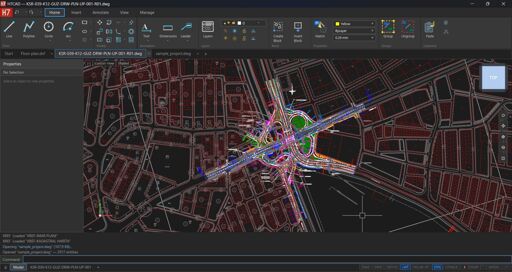
A full-featured 2D + 3D CAD application built in Rust with GPU-accelerated rendering. Native DWG & DXF read and write, paper space, ACIS solids, dimensions, layouts. An open source community project by Hakan Seven, recognized and promoted by the OpenAEC Foundation.
You must log in or register to comment.
I’m allergic to AI code. It’s worse than spaghetti. I wish it wasn’t AI-made, for the most part.
so you haven’t tried it.
Spaghetti is pretty good.
Besides all the whining here, is the program actually good? Does it work? Is it buggy?
If people can create useful working open source software using LLM’s then I don’t really care an LLM wrote it.

Claude directly has over 1100000 lines of direct code contribution. It has pretty much the same amount of code committed directly as the creator has.
His entire coding history before Claude consisted of changing readmes or searching and replacing project name text or modifying a dead link to his own link.
Suddenly in 4 months, without ever producing actual code before, he becomes a very competent coder enough to tackle mCAD, a notoriously difficult coding task that takes many many years with teams to make meaningful progress on?
That is vibe coding.
And his co-contributer “gianlucafiore” is exactly the same story. Has literally only made issues until LLM coding got released and then late 2025 (December) switched to making commits that he badly copied from an LLM such that some of the commits are literally one full line (as direct in-file working of the LLM wasn’t as accessible then)
That is vibe coding.
So the top 3 contributes are
- An LLM
- Someone that only has committed any code via an LLM
- Someone who has only made issues before beginning with an LLM and submits clearly generated code
There is likely no human-made code in the entire project besides changing a couple links.
Holy shit
Oh no!
Anyway…
He did a great job, even with AI I will hope to donte to him
shame
I’m a bit weary about Claude being the top contributor
While a steep learning curve, I think moving forward with cadquerry or other programming based approach will be the best way to future proof your cad workflow
The interactive approach should be just as future proof. Programmatic interfaces are not really suitable for many designers. Who work more intuitively with direct visual interaction. I couldn’t imagine doing really complex stuff programmatically.
Exactly. I mean, I like OpenSCAD, but there are things that are effectively impossible to do in it that are easy with a more visual piece of modelling software. Good for utility parts that need precise tolerances, not so good for dragon statues.
dragon statues I dont think would fit into cad. Blender is the way to go for that.
Most engineering problems need utility parts that need precise tolerances.
Unless it’s capable of using GPU for actual CAD and not just rendering, I may stick to FreeCad.
Does it do parametric model designs?
The primitives are parameric. I’d assume ACIS solids are too? You can try it out yourself by following one of those links.