Animals are alive; they are living beings, same with bugs and insects. What do you think goes through their minds? Especially insects like flies, ants, spiders, etc., especially when they’re so small and can die so easily?
I’m currently reading a book (Robbin Hobb, Farseer trilogy pt. 2) that deals with this.
I really like how it describes animal thought & communication:
The author translates very reasonable impulses and non-language thoughts for a dog/wolf to have into prose that the hero of the book can relate and respond to. Yes, they have a telepathic connection; that’s the fantasy part.
It’s not precise of course, but I find it pretty reasonable from a scientific pov while still fit for a fantasy novel.
Basically, the above exapmple and I agree with the currently top comment by @e0qdk@reddthat.com.
Good book!
I suspect most of them do not have an internal monologue in the same (verbose) sense that humans can have, but the relatively closely related ones (e.g. mammals, probably) likely have similar memory/sensory integration experiences. It’s possible to get your own inner monologue to “shut up” for a bit, and just be and feel and do. You can still remember an experience without talking to yourself about it as well. I suspect that closely related animals’ experience is like that – although differing based on the particular set of senses and drives unique to their species.
The further away you go from that, the less idea I have of what’s going on (besides “state machine” of some sort). I have only the vaguest notion of what it might be like to be a spider, and even less of an idea of what it’s like to be a starfish.
It’s possible to get your own inner monologue to “shut up” for a bit
The only way I know how to do this is to go to sleep. This is somewhat impractical except at one specific time, and I need to be tired to do it.
Meditate, man.
Because that is easy.
It’s not really something you succeed at, it’s something you practice. I think a lot of people shy away from it because they feel like they fail if an intrusive thought works its way in, but that is literally all part of it. Even the masters out there are having a random thought or fall asleep from time to time.
The key, in my opinion, is acceptance that there is no real victory or loss in meditation, just a continual practice that is likely to improve at times and get harder at others.
Focus on just your breath. If another thought comes in, allow it, and then return to your breath. If you can get little windows of singular focus, then you suddenly find yourself separated from the stories we tell ourselves to build our mental realities. Of course, even realizing that you’ve succeeded in that means that you failed step one: focus on just your breath.
Hmm. I’m not exactly sure how I got there or what would work for other people, but it can be done.
Maybe try thinking of it like pressing the clutch in a manual drive car? The engine might keep spinning, but if you hold down the clutch and ignore it eventually it’ll run out of gas…
Or maybe think of it like tuning out someone annoying chattering nearby. They might keep talking for a bit but if you ignore them, eventually they’ll get bored and shut up / leave. Even if they come back, just ignore them again if you don’t want to engage.
Or, try focusing on sensory details instead of mental chatter. Really notice what you’re seeing/hearing/feeling without actively describing it or planning anything.
I don’t usually stay in that state all that long, but sometimes it’s nice to just be.
Fruit flies have been studied very thoroughly in this manner. A lot of their brains are hardwired to sensory inputs and motor control, but the interesting thing is that their thoughts aren’t just made up of the connections between nervous tissue; the connective tissue itself is also used to store and modulate information.
What they don’t have is a highly developed cerebral cortex; so while they can feel pain and anxiety and probably anger and frustration, they don’t have much ability to reflect on any of it after the fact.
Animals that can do that include cats, whales, elephants, octopuses, parrots, ravens and jumping spiders.
Relevant SMBC: https://www.smbc-comics.com/comic/bot-3
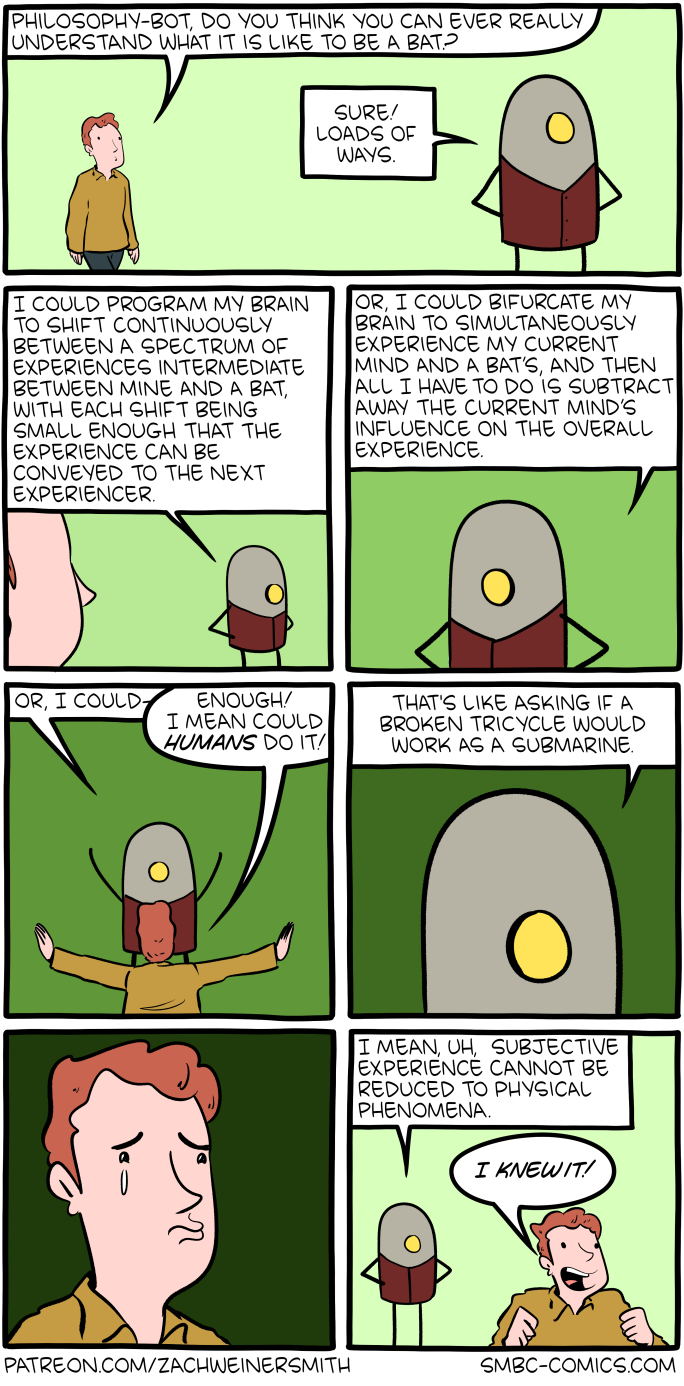
It’s not insightful or anything, but I think it’s an interesting coincidence that you’re asking this question so soon after it was published.
“That thing over there looks interesting. Can I eat it? Or fuck it? Nope, nevermind then. That reminds me, I’m hungry and horny… as usual.”
Yes yes, that’s very interesting. But what do you think is going through an animal’s mind?
Similar, but with less existential dread
Especially when you get down to insects, I imagine it as no thought, just programmed responses
What goes through the mind of a doorknob?
I always wonder what my dogs are dreaming about when they start making noises and moving their feet while completely conked out. Especislly my husky girl, cuz she is pretty quiet for a husky; she makes more whimpers and howls in her sleep than she does even when she’s hyped up and awake.
I follow “Whataboutbunny” on socials. She’s a sheepdog doodle that communicates with buttons for words, and they (she and her humans) talk about dreams.
She dreams about “stranger animal”.
Mine does really small, quiet barks and “runs” in her sleep. We think she’s chasing birds in her dreams which is her favourite daytime activity
My cat woke us both up out of a dead sleep with a random hiss a few weeks ago. Felt bad that she must have had some kind of bad dream but we both fell back asleep pretty quickly.
She drove that thing back into your closet and that’s the best you can do? She saved your whole family
Most of the things you mentioned like insects and spiders don’t have a mind. Their brains are too small for anything resembling a mind. It’s all instinct, learnt responses based on stimuli.
Something like a cat or a dog is smart enough to have some kind of internal concept of the world around them, but still very limited. It’s hard to say how much of a mind they have, but it’s much simpler than the one humans have. There are simply cognitive tests one can do on small children, which most animals fail. Although cats are notoriously hard to test in these kinds of things, because they don’t give a fuck and if they don’t feel like cooperating they just won’t.
But humans are unique in this aspect, the way we have minds is something no other animal has. It’s the unique trait that has made us masters of this planet (for better or worse, probably worse). Perhaps some animals like dolphins and some apes can come closer, but their mind would be similar to a very young child at best.
Most of the things you mentioned like insects and spiders don’t have a mind. Their brains are too small for anything resembling a mind.
Jumping spiders have an interesting amount of cognition, more than I would’ve thought, and especially for their size.
Yeah definitely, they are some of the smartest spiders out there.
I would recommend the book series Children of Time, which heavily plays with this concept and is an overall good time.
It’s hard to say if they actually have mind tho. I guess it would depend on the definition of what actually is a mind. And then you quickly get down into metaphysical stuff. We also like to frame stuff in terms of human concepts (which makes sense, being human), where the mind of an animal (especially something like an octopus with it’s more distributed intelligence) might be so foreign or alien it doesn’t even compare.
Like the human animal’s mind, except with less self awareness, less reflection, less contemplation, less hypotheticals, less mental gymnastics, less moral quandaries, less planning, less worries, less memories, less relationship drama, less existential angst, less sleepless nights remembering cringe moments… Depending on the other animal species and the individual.