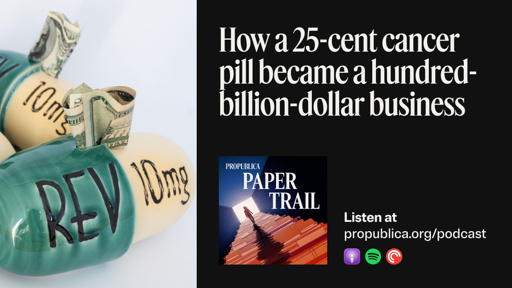
This is real.
I worked in blood diagnostics at one point and the markup was crazy. It was like the manfacturer would make it for pennies a test and sell it for a dollar a test and the lab would charge ten dollars which would result in a fee from the provider of a hundred
The generic name for Revlimid is Lenalidomide.
"Since its initial approval by the Food and Drug Administration (FDA) in December 2005 for the treatment of certain cancers, the price of Lenalidomide, manufactured by Celgene, has risen significantly. At its launch, the cost per pill was $218, equating to an annual cost of approximately $55,000 for a standard regimen. Following FDA approval for multiple myeloma in mid-2006, the price per pill increased to $280, or about $70,560 annually. As of 2023, the price per pill had reached $892.Since its approval, Revlimid cost has increased 26 times. According to a deposition by a Celgene executive, marked as highly confidential, the manufacturing cost of each Revlimid pill has remained approximately $0.25 throughout this period. Celgene claimed its patent protected Revlimid until 2027, and has engaged in several practices to prevent other manufacturers from producing a generic version of the drug, including refusing to sell the drug to other drug makers for testing purposes." https://en.wikipedia.org/wiki/Lenalidomide
Lenalidomide became available as a generic medicine in the Netherlands in 2022. The price in the Netherlands then dropped from €218 to €0.90 per pill. https://www.margriet.nl/gezondheid/kankermedicijn-revlimid-goedkoper-waarom~b43e1f4b/
Disgusting.
I also hate the system (and I work in research, meaning that my work directly goes into the profits of these companies) however it does eventually lead to better drugs getting developed and through the years their prices do decrease steeply once the patent terminates.
I hope we came up with a better system to handle this.
I’d like a public European pharmaceutical company to exist, that would solve many of these problems.
We should gamify it. We should socialize the medicine, so everyone can afford it - I mean, come on- but then:
If you work in a lab which creates a life saving drug - you get a ticker tape parade through every fucking city in the USA - you get a bronze statue in the “park of medical heroes.” Everyone knows you as “the man who fucking cured HSHBRHF variant 4x.”
Better than a parade for some athlete or sports team of dubious value.
their prices do decrease steeply once the patient terminates.
DAE read this as patient‽
Nope.
Fucking evil.
Here it’s provided for free by the public health system.
This is America.
Babe, wake up. Insulin 2 dropped.
Pharma profits are too high, but you can’t really tell by that kind of comparison. The parent company (Bristol Myers Squibb) that produces Revlimid has profit margins around 30% which is high, but obviously nowhere near what those numbers suggest.
The difference is the cost of development of both successful drugs and drugs which go nowhere. So if the company made zero profit by reducing prices across the board, the price of Revlimid could come down to $666 per pill, still each costing 25 cents - that obviously still looks crazy!
How much do executive payouts, lobbying, and marketing costs take out from those profit margins?
At least some of this information is publicly available and you can go look it up. Or I can. But before that, what do you guess those costs are? Their yearly revenue is about $48bn, to give you a starting point.
My point is that the only way to make sense of this situation is to look at it in another way, and if you do look at it that way, you see that, yes, they are making excessive profits. But not so excessive as the original perspective would say.
In case you’re skeptical still, take your estimate and ask: do you think the company spends so much on all of those items that it would make a comparison of the price to the cost of manufacturing an individual pill look reasonable?
Because I don’t think there is any realistic number you can come up with that would make this line of argument sensible, which is my point. Do you complain about having to pay $10 to buy a book when printing a single book costs like $2?
$10 no.
If that book enabled sick people to continue living another year, and they started out charging $2000 and gradually increased that to $10000 while the book production cost remained at $2, there would begin to be many ethical questions.
You’re right that the per-pill cost is only the start of what it takes to develop / test / manufacture / distribute / market the pill. But the first two are done by the time the pill comes to market and the last is minimal because you have a captive market, people who have the cancer the pill is treatment for.
Increasing the cost year after year, because you have a captive market of people that will die without your product, should raise significant ethical and legal questions. Especially because large parts of the research and testing are publicly subsidized anyway.
I tend to agree.
Pharma companies could also be considered government and worker owned and pay for the cost with taxpayer money…oh wait, we already subsidize this stuff with our taxes.
oh wait, we already subsidize this stuff with our taxes.
Privatize profits, socialize losses.
The pharma industry might be the only industry that buys in tons and sell in milligram
This is why we have antivaxxers.
Who can trust an industry that so blatantly exploits the sick and the dying?
Wonder what would happen if civilians gained the means to make some of this medication at home.
probably harder to do then making simple medication like meth, tylenol. things like bioliogics, certain immunosuppressants need a technical know how, chemicals reagents,etc, need to know the chemistry behind alot of them. biologics need some organism like yeast or bacteria to make.
Most of them would be making different medications.
Really depends on what is in the pill and what happens if you get the formula wrong.
Or if some not comically evil people would hold power
The pharma industry likes to defend its pricing by saying:
The second pill cost 25¢.
The first pill cost $800 million.
What they never actually say is that the US government (thereby the taxpayers) heavily subsidized most of that cost.
Big Pharma could use its own Mario Brother, just saying.
Even if we go by 0 subsidies as an argument, anything past around the 800 thousandth pill sold has already paid for itself and is now pure profit.
The argument deserves to burn alongside whoever uses it to extort people for life saving care.
I’m on board with Wario flat-out eating the next one.
I thought waluigi was going to do the wawawewa dance in their faces
Waluigi is King
Also most pharma research is done by public universities that private pharma companies then buy the rights to.
Happy cake day.
The clinicals tend to be ran by the companies pushing for go to market. Those also cost millions
They can be. But often they aren’t fully self-funded.
Most? I’m incredulous but I don’t know the actual answer.
Brave to assume that only one country gives a subsidy.
Australia has the Pharmaceutical Benefits Scheme that does the same thing.Let’s-a go!
biologics(this includes cancer biologics, autoimmune,psoriasis, eczema, and some rare diseases) is where pharms make thier money. because they are most thousands a month, wholesale, insurance is very stingy about covering certain biologics. although some do have a “coupon” option.
The price of biologics kills me. I know it costs about $20 dollars for a month of GLP-1 agonists, because I’ve made similar peptides myself in grad school. Something like a Solid Phase Peptide Synthesizer runs $10-250K, but the cost to synthesize a 40 amino acid linear peptide at industrial scale is like…$0.30 USD per milligram. Shorter chain peptides are even cheaper. A 15AA linear peptide can be as low as $0.01/mg.
There are of course other expenses, especially labor, facilities, certification, and waste disposal, but these companies are still easily making 40-50% profit margins on biologics. Compare this to non-biologics pharmaceutical profit margins around 15-25%, or for other industry comparisons, grocery stores around 1-3%, restaurants 3-10%, and software at 15-20%.
Oh yeah love that coupon. They approve the first few months to show you it will work and then jack up the price
It’s almost like health care and free market economics aren’t compatible
This fucking disparity is why there’s now a parallel industry revolving around equally questionable alternative treatments.