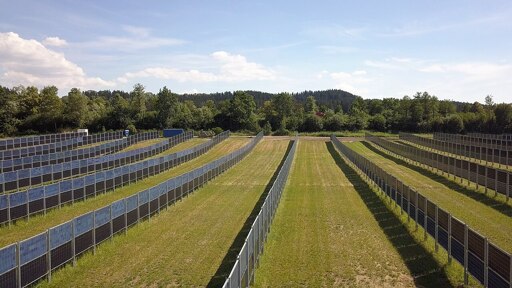
Work well in snowy climates because the reflection off the snow will cause the panels to heat up sooner and melt off snow quicker to get to full production.
I have 25kW of them but I use them for direct south-facing production, not EW. The bathtub curve of EW doesn’t produce the most power, it just matches the higher output periods to the higher demand periods if you don’t have batteries.
The biggest benefit of having them vertical with the bathtub curve is horizontal space usage. You can grow plants that love strong sun in between the rows with much more space and they’ll get mid day sun.
you can actually make these things very easily by just taking two ordinary solar panels and basically glueing them together.
Then you are paying for two solar panels. I seriously don’t think you understand what a bifacial solar cell is, stop acting so confident.
Here’s a concept image of what I have in mind for a climate change solution. Using bifacial solar cells in combination with azolla ponds to sequester carbon dioxide and produce excess electricity.

I often see farms that use this type already in my area. Its such an obvious and simple add on, because lots of plants actually prefer having less direct sun, especially when its super hot.
depends on the plant. some prefers intermittent strong sunlight, some dont mind full sun, like desert plants, or certain succulents.
This is probably the simplest and cheapest setup.

Maybe. The point of vertical biracial panels is less need for batteries, or counterbalance generation. When you look at the system as a whole, it may be simpler and cheaper over everyone installing panels with a strong peak in the afternoon when no one is using it
Indeed, but the problem is they don’t provide shade. Vertical panels would work really well for sun loving plants though, not really for azolla unfortunately.
I read more about azolla and direct sun, so really it would need to be shaded, and that’s fine, as long as we shade it with solar panels.

Awesome, yea I think that’s why this is actually feasible. You’re taking an idea that is already proven to work, and then you simply just add value by making the land more productive with very little extra investment.
uhm, that’s not economical. to effectively transform a worldwide energy supply (that’s a very high amount of energy throughput), you need economic advantage. and this isn’t it. please put the solar panels at an angle sothat they collect more sunlight or the solar park isn’t gonna pay itself off anytime soon.
The University of York compared panels capable of 1.5 kW and found that vertically mounted bifacial panels generally outperformed tilt mounted monofacial panels, by between 14-27% on a monthly basis, at least when surrounded by gravel, in the climate/altitude of that particular location.
The reason given is that vertically mounted systems capture a lot more indirect reflected sunlight from the surroundings, across a wider range of conditions.
Vertical solar panels are looking to be quite economical. While there power per panel surface is lower, the timing of peak outputs is an excellent complement to standard solar. It has maximum output in the morning and evenings, when people want to run home appliances etc, rather than at midday when they are all at work.
It also uses less land. Rather than giving up 100% of a field to solar, A farmer can give up 20%, leaving the rest for crops or livestock. Apparently sheep do particularly well in this setup. The panels provide shade, and more diversity in plant types to eat. They actually do better than those in an empty field of the same size.
While there power per panel surface is lower, the timing of peak outputs is an excellent complement to standard solar. It has maximum output in the morning and evenings, when people want to run home appliances etc, rather than at midday when they are all at work.
yeah i’m well aware of that. the problem is more that you can more effectively shift power around from midday to evening and morning with batteries.
Generation on demand is still a better. Batteries are still quite an expensive option, at the scale required.
It also ignores the other benefits. The main one is allowing a combination of agriculture and power generation.
I don’t think you understand bifacial solar panels and why they are able to be vertical. Please inform yourself before acting so confident.
https://en.wikipedia.org/wiki/Bifacial_solar_cells

What would you use the azolla for? Animal feed? Which source of nutrients would you feed it with? Intensive harvesting of azolla would quickly deplete the nutrients in the water.
Great question. Several uses. especially if squeeze and dried, can be used as nitrogen fertilizer. Given the fact that azolla fixes nitrogen from the atmosphere.
Biochar: Organic carbon permanently locked into a solid form that remains in the soil for over 1,000 years, generating high-value Carbon Dioxide Removal (CDR) credits.
High-Protein Animal Feed: A cheap, highly nutritious feed supplement rich in protein and amino acids to replace land-intensive soy and alfalfa for cattle, poultry, and fish.
Organic Biofertilizer: Nitrogen-rich pellets made directly from the nitrogen-fixing fern, allowing farmers to completely bypass expensive, fossil-fuel-derived synthetic fertilizers.
I missed that azolla could fix nitrogen, knew that about duckweed but azolla is not my strength to be honest. However the question still remains, where would you get the potassium and phosphorus required to grow the azolla? All 3 of your examples involve continually harvesting azolla and not getting the nutrients back in. You could add chemical fertilizer to grow azolla into organic fertilizer but that would be kinda dumb wouldn’t it? Not to say that hasn’t been done multiple times before, looking at you alfalfa fertilizer pellets.
In a way wood is a great way to produce biochar because nearly all the nutrients in the tree are in the leaves and the branches. When harvesting wood we only take the trunk. This means we can grow wood generation after generation and we don’t have to use fertilizer. The same is not true for something like azolla. A good setup to make it cyclical would be to put the azolla right next to the animal farm whose animals are fed the azolla. And use the manure to grow azolla. However then I wonder if the hygienic quality is acceptable.
You need to learn about the growth rate of azolla to understand why it’s superior, the cycle rate is insanely fast, it grows rapidly. Yes potassium and phosphorous would need to be introduced, it would be inexpensive.
Introduced from where? That’s my whole question. Apparently you don’t know but phosphorus is a finite resource which will run out in the next 100-300 years. It’s just as fossil as fossil fuel. Any solution that uses mined phosphorus is not sustainable.
You need to learn about mass balances.
What do I need to learn about it?
Duckweed works better for animal feed since it produces far more biomass and protein per day although azola is still pretty good. Thx problem with both is dewatering and getting high enough consumption. It works as an additive but certain animals don’t like to eat pure azola or duckweed. Processing it into protein concentrate helps out though so you can feed far more to animals that would otherwise start refusing rations made with too much of either.
One thing worth thinking of would be a cooling jacket on the back of the solar panels that also heats the pond water. That makes the panel’s more efficient, only needs a small electric pump to circulate it, and makes the pond plants grow faster when it’s cold or even allowing them to be productive in the winter in certain places?
I think azolla has been floated (hah!) as a scalable way to quickly fix atmospheric carbon. Maybe fish aquaculture for nutrient restoration?
Happy cake day, and yes, both. Carbon sequestration and animal feed.
You can feed the azolla waste water from a fish farm for sure. But then what do you feed the fish? The nutrients always have to come from somewhere and they have to end up somewhere. If you’re simply dumping azolla in a mine somewhere as carbon storage that then turns into a huge waste of nitrogen, phosphorus and potassium. It’s a very nutrient dense plant.
I think the easiest option that works at the largest scale for the least money is dewatering it and pyrolysing it into carbon. You might get some of the nutrients back but most would be lost I think which is the downside. The only way to get those nutrients out is to turn it into ash which destroys nitrogen but liberates potassium, phosphorus, and other minerals.
One other option is to use it as a soil amendment. Biochar has a massive impact on crop yields (for soils that dearly need it. This isn’t universal) and the effects can last for decades or even centuries. It takes a lot of biochar to have that effect though, which azola or duckweed carbon fixing can produce in bulk.
I’ve heard something like 8-30 tons per hectare of bio char. The other benefit is while some of the carbon releases naturally over time it’s a slow process. The big benefit is water and nutrient retention without water logging your crops (in fact it helps with drainage in low permeability soils.) More beneficial bacteria and a healthier soil ecosystem.
Biochar is best made with manure and composte afterwards to preload it with nutrients otherwise it actually has a net negative effect on yields (since it’s like adding activated carbon. It absorbs everything until it’s fully loaded up with nutrients)
Yes you’re effectively sucking out nitrogen and carbon directly from the atmosphere and turning it into a solid. Furthermore, if you squeeze out all the water you get extremely dense cakes. You can use the energy generated from the solar panels to mechanically squeeze the azolla, use the squeezed out water back into the system.