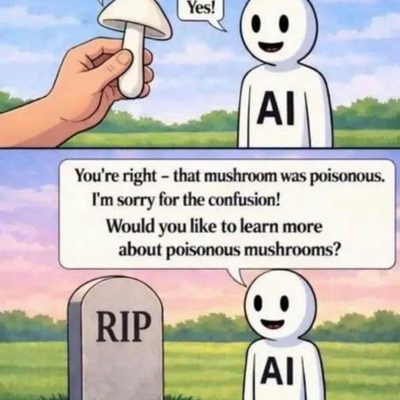

I think about this but like, I’m not sure if it’s a stupid question so I’ll put it here.
We have no idea what consciousness is.
Literally. It’s something that we all experience, but there is no scientific definition, measure, or framework to study it.
We assume it is a function of our brains, but we could be wrong. Are intelligent birds, apes, and dolphins conscious? What about lizards? Flatworms? Trees? Yeast?
If you want to go down that rabbit hole, search “what’s it like to be a bat?” or “the hard problem.”
That’s true. Every living organism could be conscious on some level if you think about it.
@bookie @gedaliyah And rivers and crystals are alive, if you define “alive” broadly enough.
What, then, makes a given definition useful? True?
What does it mean to be conscious?
Not with our current methods of AI, no.
Yeah I wouldn’t expect it right now, but maybe in the future?
Once they start integrating actual brain matter into machines, maybe. But IDK if that would necessarily answer the question of if a machine could develop consciousness, like as in just silicon alone. Is it a machine if it’s just a lab-grown brain attached to electronics? 🤔
I am skeptical that silicon alone would ever develop consciousness, personally.
To answer that question we would first need to understand what consciousness is and how it arises.
Expanding on that: until we can prove that another human being is conscious, it’s highly unlikely that we’ll be able to do so for a machine.
We would need to solve a few dozen philosophical questions before doing anything more than replicating by mimicry. Like some kind of sociopathic entity masking it’s behaviours to seem neurotypical. Probably look like some super jacked Austrian dude who’s going to be back later or maybe a silver surfer in a cop costume, who knows.
It is not a stupid question.
AI is a statistical model. It emulates how we speak and therefore mimics how we think. But there are essential differences currently.
The size of AI-models is way less than that of our brains (comparing nodes to brain cells) by several orders of magnitude. AI models do simulate associative thinking and pattern thinking really well in some ways, but not very well in others. While an AI can have different sections of brain that can go back and forth (Mixture of Experts), they usually only pass raw numbers through the model one way. Our brain afaik is unidirectional with its electrical signals.
I’m saying this because an AI and a brain have fundamental differences we won’t be able to eliminate as of now. Which means a traditional consciousness as we know from humans or animals in some cases is hard to presume.
That said, a lot of experts recently raised alarms because what is classified as a person, when does thinking start and stop, all of these ethical boundaries need more strict definitions law-wise, because we are definitely fishing at the boundaries.
I know Lemmy doesn’t like AI and will highlight these fundamental differences, but the ethical questions raised are indeed part of a growing corpus of science currently.
“AI” consists of statistical prediction models with output. We’ll get Asimov’s psychohistory before we get conscious Gen AI.
LLMs are zip files, not analogous to brains. Model training is a lossy compressiom algorithm.
There are degrees of awareness. Consciousness is a broad part of that, but usually it’s sentience and sapience that are really considered in this question, and they are two different things. Usually sentience is used when it’s actually sapience that’s being discussed.
LLMs as they are aren’t aware. They respond to input, but there’s nothing going on internally to suggest they “know” what’s being asked. The lack of long term context and memory is a huge issue that external tools and techniques try to counter.
But to answer the question, we still don’t know. Before everything got sidetracked onto the LLM ride, it was one of many ideas on how to develop thinking in a computer. I don’t know if other research is still going on and just hidden behind the frenzy, or got cut out to go down this singular path that looked profitable.
I heard there is research to build world models, so I believe they are still trying to build AI beyond LLMs.
The scariest part of this question is that we would have no way of truly knowing.
Not a stupid question. It does not look like at the moment, wouldn’t say it’s impossible though. As we progress with better and better technology I personally think it is an inevitability.
There a plenty of science fiction books and shows that focus on this.
Coz AI copies us and learns from us, if it did, i would kinda expect it to just act more like us but maybe smarter?
I’ve interacted with quite a few people in my day, and I can’t see how the robots could be much dumber than them.
Currently? No. In the future? Who knows?
Hypothetically, if we got to the point that we could simulate the collective synapses of a human brain in real time, that should do it.
Hypothetically, if we got to the point that we could simulate the collective synapses of a human brain in real time, that should do it.
If you simulate fire, does it burn? I don’t think a simulation will do it. I think consciousness is an emergent property, but unlike others here I’m not so sure this property has to emerge from an organic substrate. Organics might just be the cheapest way nature found to do it.
Problem is, we don’t really understand consciousness itself, and that makes it hard to predict where or how it will show up.
Cute that you think synapses are the defining factor.
No
No, because they’re not alive. It’s no different from asking if a rock can grow a tail. Consciousness is a function of living brains. It helps living things avoid threats and react to unfavorable conditions.
I don’t think you need consciousness to avoid threats or pain. Stuff like slime molds exist.
They could be conscious for all we know.
My counter: what does it mean to be alive? Seems like biologists struggle with this when considering viruses, since they act in a very predefined and mechanical way.
I don’t see it has to far fetched for a computer or other machine to straddle a similar boundary.
It means your cells contain DNA that can reproduce. Things that are not alive do not reproduce.
I must beg the question: what is it that makes Deoxyribonucleic acid so special? Is it possible that different specific set of chemicals could achieve the same thing? Would this same polymers not be an alternative building block of life?
To try to preempt an answer: they act as instructions for self replication. I would then conjecture that and machine designed to take in a set of input material, read a set of self replication instructions, and out put an identical copy would also be alive.
I had a similar disagreement with a coworker some time ago, who’s core thesis was that AI could never gave a soul because God is the only thing that can give something about soul, all of which is nice and unprovable in any kind of scientific sense. It feels like you’re making a parallel argument here.
If a machine was made that could make copies of itself… it wouldn’t be alive. It’s not a simple definition. Some viruses use RNA or single strand DNA and don’t reproduce themselves, they use other cells to do it for them. But they are alive in some sense of the word.
Try harder. There are MANY reasons modern “AI” is trash. Being “alive” and avoiding negative stimulus is NOT one of them. At all. It’s not even part of the real definition of life that has persisted for decades.